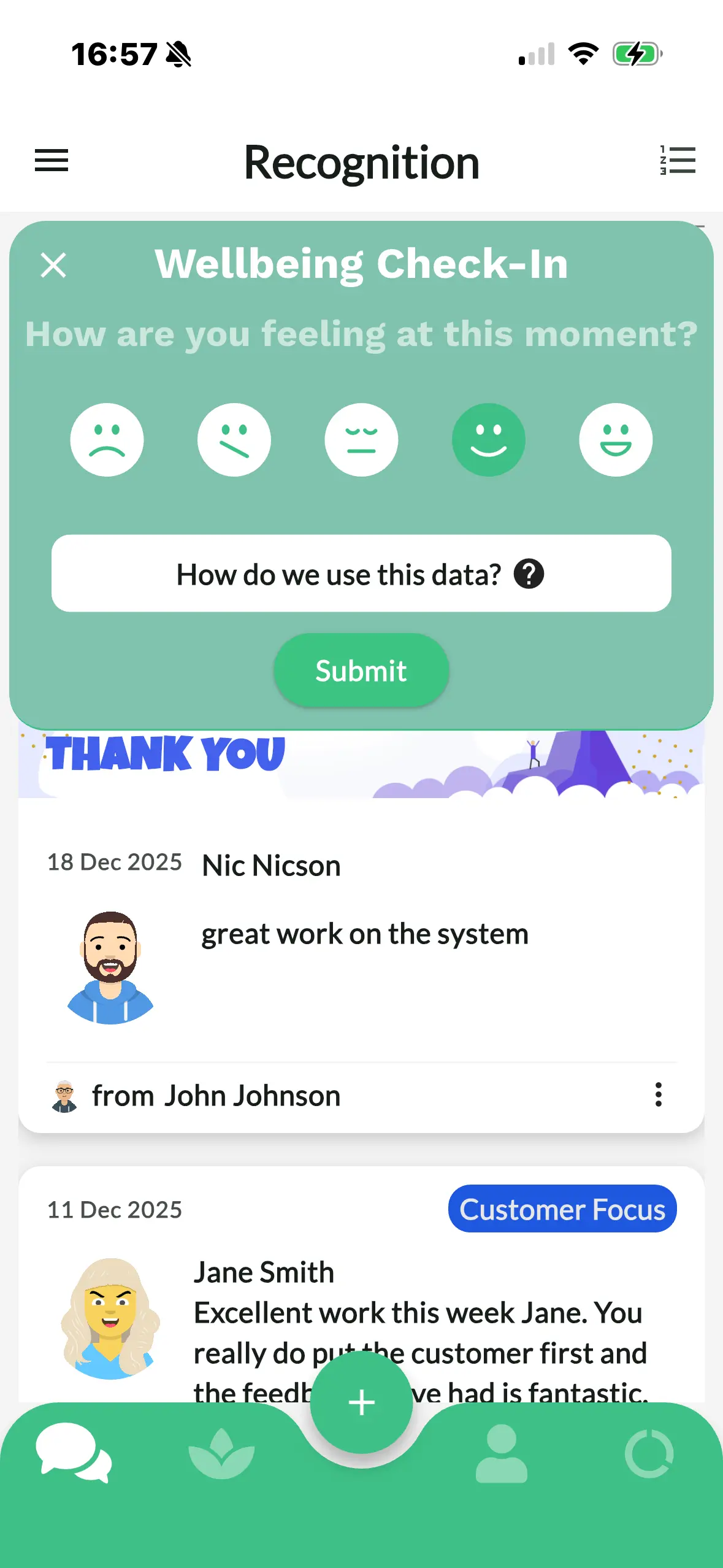
A simple, non-intrusive prompt that lets employees share how they’re feeling — physically, mentally and emotionally. Individual responses are never retained; only anonymised, aggregated trends are visible to authorised leaders. The result: honest sentiment data leaders can act on, and a wellbeing programme employees actually trust.
Most wellbeing programmes ask employees to give up too much — their time, their privacy, or both. VALU’s are designed differently.
Individual responses are not retained. Authorised users see only anonymised, aggregated trends. Employees can see for themselves before they submit that there’s no way to trace a response back to them — which is what makes them willing to answer honestly.
A simple, non-intrusive prompt that fits inside how employees already use VALU. Quick enough to actually complete; frequent enough to build a trend line. Never mandatory, never penalised for skipping.
Employees are signposted to validated wellbeing resources from sources such as the NHS API — not generic motivational content. The check-in surfaces sentiment; the integrated content gives employees somewhere to go with it.
Wellbeing Check-ins give employees a simple way to share how they are feeling physically, mentally and emotionally. Crucially, these check-ins are completely anonymous – no individual records are retained. Responses are aggregated to provide an overall picture of organisational wellbeing, never to track or identify individuals. This creates value for employees and organisations alike.
For employees, Wellbeing Check-ins offer reassurance that their employer genuinely cares about them as people, not just as productivity units. Because no individual data is stored, employees can reflect honestly on stress levels, workload, morale or work-life balance – without any fear of judgement or repercussion. Employees feel seen, listened to and supported, which strengthens trust and psychological safety. The initials of VALU stand for Voice, Appreciation, Loyalty and Understanding. Giving staff the tools to anonymously share aspects of their mental health and wellbeing is addressed by all four of those initials.
For employers, the aggregated insights are equally compelling. Retention costs less than recruitment, and understanding overall wellbeing trends provides early warning of emerging issues such as burnout, disengagement or workload imbalance across teams. Rather than reacting to absence, staff turnover or performance problems after the fact, organisations can take preventative action. A proactive approach often results in reduced sickness absence, improved morale and stronger long-term retention.
Importantly, because responses remain anonymous and unattributable, Wellbeing Check-ins encourage more honest input than traditional surveys or performance reviews. They acknowledge that wellbeing fluctuates and that support needs change over time.
Performance and wellbeing are inseparable. Employees who feel overwhelmed, unsupported or burned out are far less likely to sustain high performance – no matter how generous the rewards. By integrating VALU Wellbeing Check-ins into your Recognition & Reward policy, you send a powerful message: wellbeing is valued as highly as output.
The aggregated, anonymous wellbeing data feeds directly into VALU's unique Employee Balance Sheet® – a comprehensive scoring system that helps organisations understand the true health of their workforce. By combining wellbeing insights with recognition activity and engagement metrics, the Employee Balance Sheet® provides a holistic view of organisational culture that goes far beyond traditional HR metrics.
Wellbeing Check-ins are not about surveillance or box-ticking – quite the opposite. With complete anonymity and no individual records retained, employees can share openly without concern. The aggregated data helps organisations understand overall wellbeing sentiment, not monitor individuals.
Thoughtfully implemented within VALU, Wellbeing Check-ins become a strategic tool for building healthier, more resilient and more engaged organisations. The insights contribute to your Employee Balance Sheet® scoring, giving leadership a clear, data-driven understanding of workforce wellbeing. Everyone benefits. And it's good for business.
Completely anonymous with no individual records retained. Employees share openly, knowing their responses can never be traced back to them.
Monitor wellbeing trends over time. Identify patterns and spot potential issues before they become problems.
Turn feedback into action. Get clear insights that help you make informed decisions to improve workplace culture.
Employees receive a simple, non-intrusive prompt to share how they're feeling.
They respond anonymously, choosing from mood options or adding optional comments.
Responses are aggregated at organisation level. Authorised leaders see anonymised sentiment trends — never individual responses.
Leadership uses insights to implement targeted wellbeing initiatives.
Continuous sentiment data instead of waiting on annual survey cycles. Trend lines show whether interventions (manager training, workload reviews, new EAP) are actually moving organisational sentiment.
An anonymised, organisation-wide read on workforce sentiment that feeds the Employee Balance Sheet®. Early warning signals appear in trends, not in after-the-fact absence or attrition data.
Mobile-first check-ins reach employees without dedicated desks. The two-second design means it actually gets used by staff who don’t have time to sit through a 30-question survey.
Distributed teams lose the informal “how are you doing?” signals managers used to pick up in person. Anonymous check-ins put a structured equivalent in place — without turning it into surveillance.
Individual check-in responses are not retained. Authorised users only ever see anonymised, aggregated trends at organisation level. There is no mechanism to attribute a response to a named employee, and employees can see this for themselves before they submit.
Check-ins are designed to take around two seconds, prompted on a cadence (typically weekly) that fits an employee’s normal use of the platform. They are non-intrusive and never mandatory — employees can skip a check-in without penalty.
Aggregated, anonymised wellbeing trends are surfaced to authorised users via sentiment dashboards and feed into the Employee Balance Sheet® (an organisation-wide composite score). Site and department-level breakdowns are on the roadmap, with minimum-cohort thresholds to preserve anonymity for smaller teams.
Wellbeing trends are one of three data streams that build the Employee Balance Sheet®, alongside recognition activity and engagement metrics. Leaders can correlate the three streams to see how recognition activity and wellbeing sentiment move together over time.
VALU surfaces sentiment trends, not prescriptive recommendations. The platform also signposts employees to validated wellbeing resources (for example via integration with the NHS API), but the decision on which programmes to invest in stays with HR and leadership.
Check-ins are designed to be quick and consistent, so trend lines stay meaningful over time. Each type of response is weighted equally for fair and consistent reporting. Customisation is best discussed during onboarding to match how your organisation talks about wellbeing.
Two-second check-ins, no individual records, aggregated sentiment that feeds the Employee Balance Sheet®. See how VALU Wellbeing Check-Ins work alongside recognition and reward.
Schedule a Demo